Falsework is not only a means of ensuring safety but also functions as a piece of production equipment designed to achieve both shorter construction timelines and stable quality. It is important to identify the constraints specific to each site, accurately design the load paths and reaction conditions, and select and operate a system that corresponds with the construction cycle.
This article provides a summary of case studies categorized by construction sector.
In residential new construction and renovation projects, buildability is affected by various factors, such as the limited size of the site, the surrounding environment, the feasibility of construction while the home is occupied, and the availability of a crane.
The following article uses case studies to explain strategies for maintaining safety margins and stabilizing the daily schedule even within limited working spaces.
It is common to proceed with construction without halting business operations, with short-duration nighttime work and the separation of circulation routes being key factors. Falsework is essential for managing the increase and decrease of loads while upper floors are in use, avoiding interference with ceiling-mounted equipment, and ensuring adequate reaction forces when creating new slab openings or jacketing beams.
The following article uses case studies to explain the renovation and interior reinforcement construction of facilities.
It is important to evaluate the impact of ground conditions, groundwater, and surrounding structures. Utilizing falsework directly contributes to the stability of earth-retaining structures, the arrangement of struts and walers, and the resolution of interference with structural construction. Displacement management based on measurement data is a fundamental prerequisite for safety.
The following article provides a detailed explanation of case studies of falsework systems in excavation and tunneling construction.
Minimizing traffic impact and ensuring safe temporary supports are crucial. In tasks such as bearing replacement and deck slab replacement, the stability of temporary bents, travelers, and suspended scaffolding, as well as the management of reaction forces on existing structures, are critical for success.
Redundancy to withstand variations in wind, temperature, and traffic loads, careful planning for works over rivers and marine environments, and meticulous preparation for load transfer to components affected by corrosion and fatigue are essential.
We have compiled case studies on the utilization of falsework props in bridge repair projects.
In the aftermath of earthquakes or heavy rainfall, preventing secondary disasters and ensuring safety as quickly as possible are top priorities. Falsework must be able to immediately respond to emergency support for walls, beams, and roofs at risk of collapse, temporary stabilization of tilted buildings, and urgent reinforcement of slopes and bridge piers.
Rapid deployment using modular equipment, securing resident pathways, establishing access for heavy machinery, and coordinating with rapid hazard assessment protocols are essential.
The following article provides a detailed explanation of case studies on the use of falsework props in disaster recovery construction.
In the construction of slabs for high-rise buildings, it is critical to balance cycle time reduction and safety. Falsework is directly linked to the integrated management of falling-object prevention and edge safety, load management during early dismantling and back propping, assurance of deflection and finish accuracy, and maximization of lifting efficiency.
On the premise of parallel construction with cores and walls, the adoption of table-form systems and drop-head methods, together with the selection of highly reusable components, proves to be effective.
We have compiled a summary of slab support in high-rise buildings, along with case studies on the use of falsework props.
Advertiser Disclosure:
We receive compensation from some of the companies listed below.This compensation may affect which companies are included and the order in which they appear.
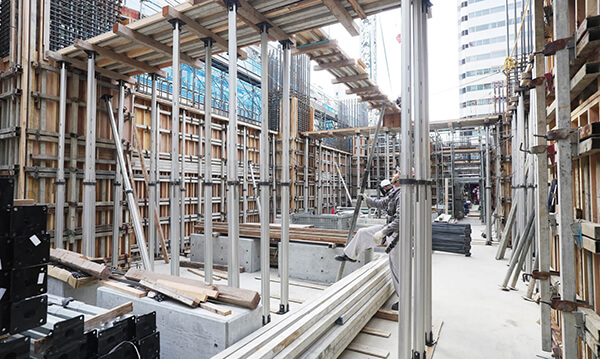
Source: https://www.forbuild.co.jp/material/alpa.php
| Unit Weight |
8.9/11.1 kg |
|---|---|
| Load Capacity |
19.0~36.0 kN* |
| Material | Aluminum |
| Max Length |
3,490mm |
*When the upper end is fixed to timber and the lower end to concrete
*Based on the ARPA 45 model.
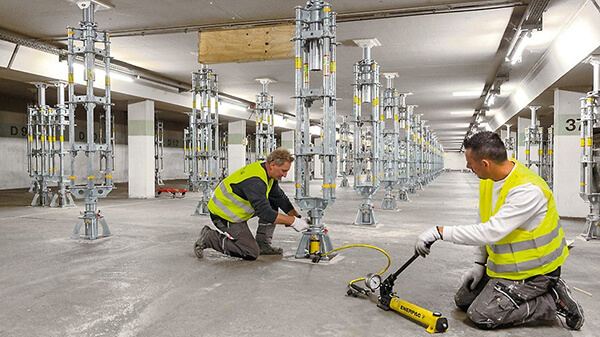
Source: https://www.peri.ltd.uk/products/peri-up-flex-heavy-duty-prop-hd.html
| Unit Weight |
91.03~265.98kg |
|---|---|
| Load Capacity |
Up to 200 kN |
| Material | Steel |
| Max Length |
Approx.8,330mm |
https://www.peri.ltd.uk/dam/jcr:cb5a5bf0-8e05-4d70-b6fd-780f3cf91333/peri-up-flex-hd-prop.pdf
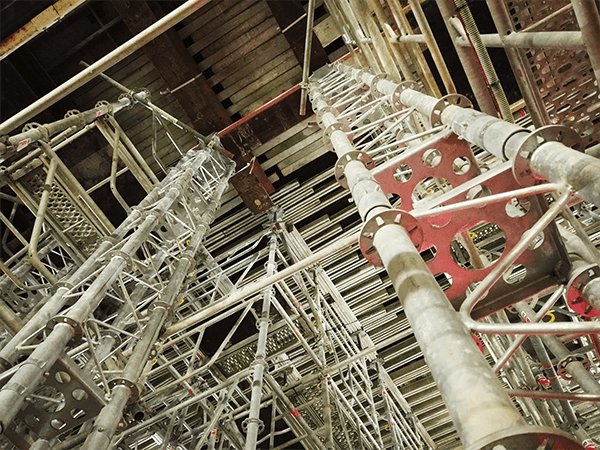
Source: https://www.altrad-coffrage.com/en/solutions/shoring/props/tetrashor.html
| Unit Weight |
Approx. 131–159 kg |
|---|---|
| Load Capacity |
Up to 400 kN* |
| Material | Hot-Dip Galvanized High-Tensile Steel |
| Max Length |
17,000mm* |
*Applicable to single-leg prop configuration onl
