In residential construction and renovation projects, the selection of falsework, formwork, and climbing systems based on site conditions is directly linked to both shortening the construction timeline and maintaining safety.
In this article, we have summarized falsework props and related systems used on construction sites through case studies.
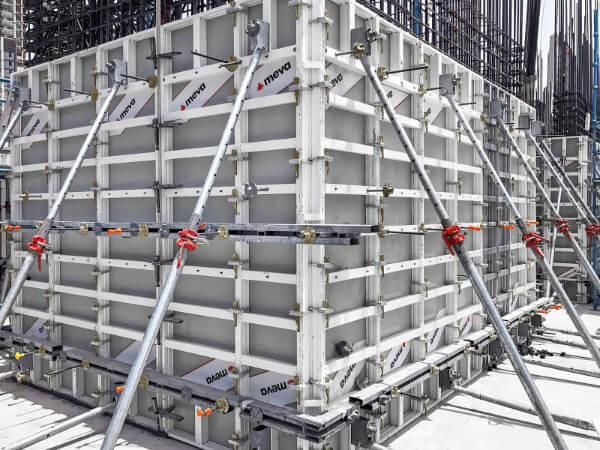
This is a case study of renovating an existing residence in an urban area. During the process of significantly increasing the ceiling height of the basement level, workers encountered challenges such as confined spaces, access restrictions, and lifting constraints.
The lightweight hand-set formwork AluFix was used to facilitate the expansion of underground ceiling heights from approximately 1.8 meters to 3.7 meters, and to address the constraints of unilateral construction and limited crane use.
The aluminum frame allowed for manual transportation, thus making underground delivery easy. MEVA’s STB 300 support frame was used to resist the concrete lateral pressure generated by one-sided formwork and to safely form the rising wall.
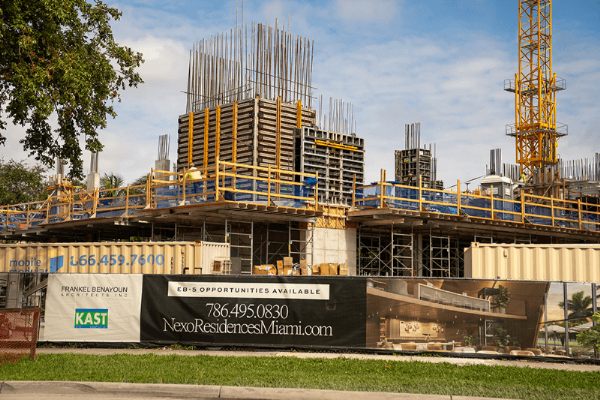
This is an example of a 16-story residential building. ULMA’s formwork and falsework prop systems were used in combination to accommodate a vast deck (with a total slab area of approximately 600,000 square feet) as well as the diverse casting requirements of cores, walls, and columns.
ULMA has a system that provides molding and falsework as a one-stop solution, allowing for the integration of frame falsework, handset systems, climbing systems, and shaft platforms (shaft scaffolding). This enables the streamlining of processes such as reconfiguration between construction stages and the management of falsework removal.
In mid- to high-rise projects where deck work and core work proceed in parallel, a functional allocation—using frame falsework for floors, climbing systems for cores, and shaft platforms for vertical access—has proven effective in achieving a balance between construction schedule efficiency and safety.
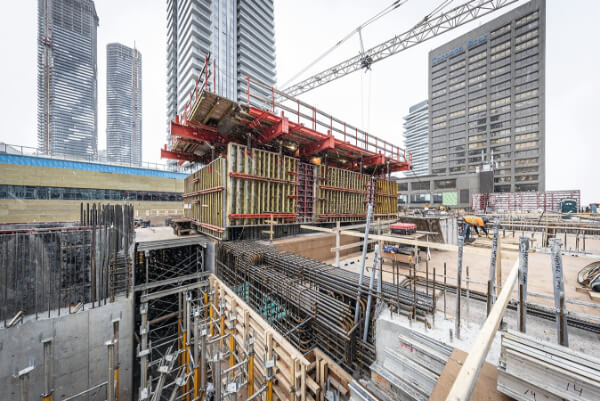
In the construction of super high-rise buildings, the performance of climbing formwork used to advance the elevator and stair cores ahead of the surrounding structure directly affects both the speed of topping-out and overall safety.
PERI’s self-climbing ACS Core 400 was used during the construction of a super high-rise apartment in Toronto. This allowed the core formwork and work platforms to ascend as a single unit without reliance on cranes. Its design allows it to accommodate changes in core geometry from lower to upper floors, while hydraulic cylinders reduce the number of anchors required and simplify reconfiguration operations.
Advertiser Disclosure:
We receive compensation from some of the companies listed below.This compensation may affect which companies are included and the order in which they appear.
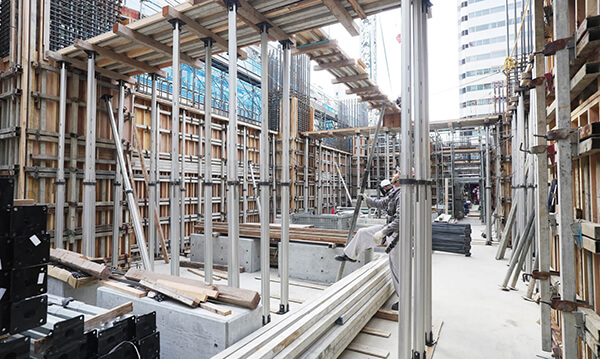
Source: https://www.forbuild.co.jp/material/alpa.php
| Unit Weight |
8.9/11.1 kg |
|---|---|
| Load Capacity |
19.0~36.0 kN* |
| Material | Aluminum |
| Max Length |
3,490mm |
*When the upper end is fixed to timber and the lower end to concrete
*Based on the ARPA 45 model.
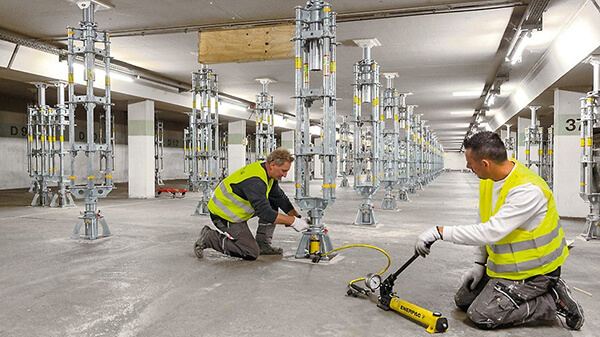
Source: https://www.peri.ltd.uk/products/peri-up-flex-heavy-duty-prop-hd.html
| Unit Weight |
91.03~265.98kg |
|---|---|
| Load Capacity |
Up to 200 kN |
| Material | Steel |
| Max Length |
Approx.8,330mm |
https://www.peri.ltd.uk/dam/jcr:cb5a5bf0-8e05-4d70-b6fd-780f3cf91333/peri-up-flex-hd-prop.pdf
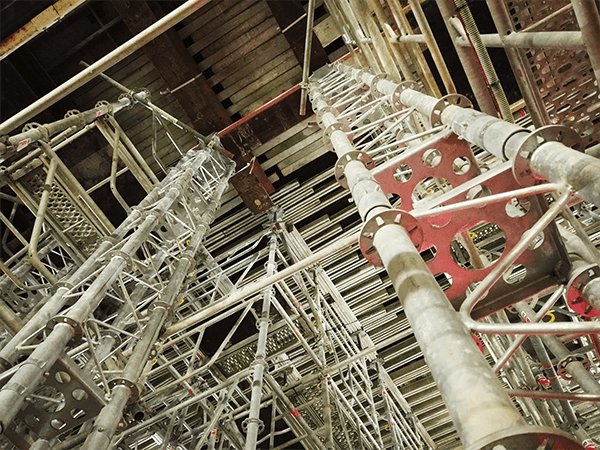
Source: https://www.altrad-coffrage.com/en/solutions/shoring/props/tetrashor.html
| Unit Weight |
Approx. 131–159 kg |
|---|---|
| Load Capacity |
Up to 400 kN* |
| Material | Hot-Dip Galvanized High-Tensile Steel |
| Max Length |
17,000mm* |
*Applicable to single-leg prop configuration onl
