When renovating facilities or reinforcing interiors, it is necessary to carry out demolition, renewal, and expansion in stages while ensuring the safety of existing structures. This must be done under constraints such as maintaining business operations, taking into account surrounding traffic, and preserving historical elements. In particular, shoring plans that use shoring props and jacks are factors that influence the flexibility of the construction schedule and the safety of the site.
This article summarizes case studies on facility refurbishment and interior reinforcement construction.
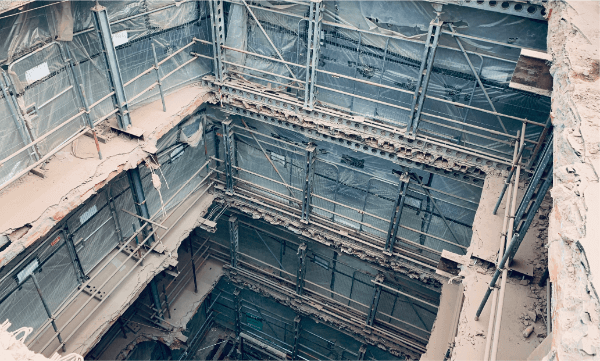
This is a case study of a temporary support plan designed to provide continuous support from the basement to the top floor, as part of a project to convert an old warehouse building into a residence.
Prior to the removal of the existing core and the demolition of the elevator shafts, lateral shoring to restrain building torsion and back-propping of floor slabs at each level were installed to take over and support the loads from above.
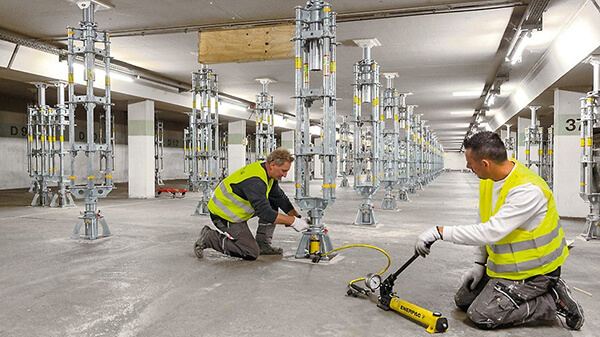
The primary shoring props and jacks on-site are a combination of Mabey Hire’s Mass50, Mass25, and System160, supplemented with hydraulic Hymat jacks.
The use of a composite shoring prop system allowed large-scale underground foundation casting and the demolition and reinforcement of the upper structure to proceed simultaneously.
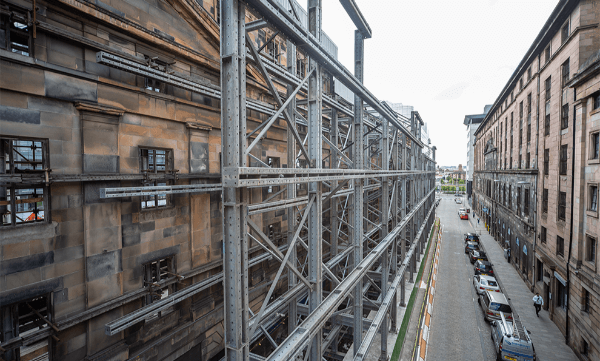
In this case study, office development needed to proceed while preserving the facades of the historic building. One of the requirements was also not to close the major one-way road to traffic. A facade retention system was adopted to allow the shoring on the facade side to be self-supporting, resulting in a retention scheme with a total capacity of 175 tons.
By minimizing the width of the shoring and adopting a seesaw-like structural configuration that utilizes the self-weight of the facade, the need for excessive kentledge (counterweights) was eliminated. This approach successfully minimized road occupation.
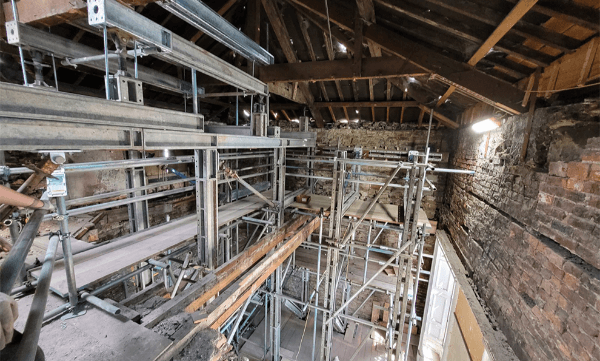
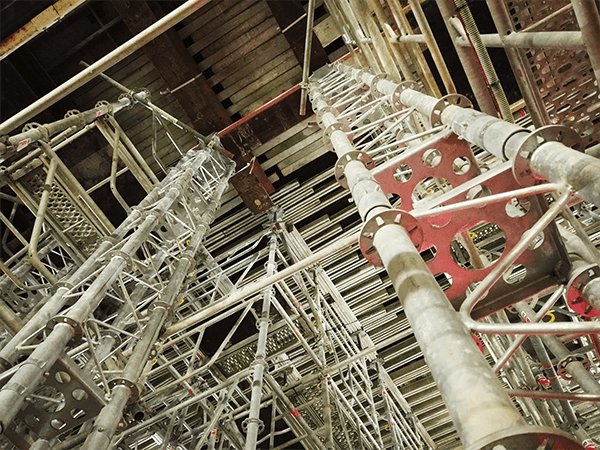
This is a case study on the extension of a historic building. For the extension, a complex shoring system was required to simultaneously protect the existing facades and roof. The construction team adopted a layout that installed tower-shaped shoring props inside the building to support the roof load while also ensuring retention of the surrounding facade.
The central product used in this case study was Mabey Hire’s Mass25, which is characterized by its flexible on-site optimization achieved by combining prefabricated modules. It is capable of supporting up to 340 kN per prop.
Assembling the shoring tower inside the building made it easier to ensure passageways and workspaces at the site. It also contributed to reducing the amount of steel used and alleviating congestion.
Advertiser Disclosure:
We receive compensation from some of the companies listed below.This compensation may affect which companies are included and the order in which they appear.
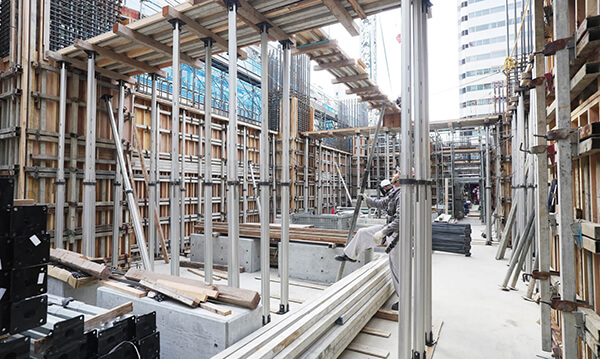
Source: https://www.forbuild.co.jp/material/alpa.php
| Unit Weight |
8.9/11.1 kg |
|---|---|
| Load Capacity |
19.0~36.0 kN* |
| Material | Aluminum |
| Max Length |
3,490mm |
*When the upper end is fixed to timber and the lower end to concrete
*Based on the ARPA 45 model.
Source: https://www.peri.ltd.uk/products/peri-up-flex-heavy-duty-prop-hd.html
| Unit Weight |
91.03~265.98kg |
|---|---|
| Load Capacity |
Up to 200 kN |
| Material | Steel |
| Max Length |
Approx.8,330mm |
https://www.peri.ltd.uk/dam/jcr:cb5a5bf0-8e05-4d70-b6fd-780f3cf91333/peri-up-flex-hd-prop.pdf
Source: https://www.altrad-coffrage.com/en/solutions/shoring/props/tetrashor.html
| Unit Weight |
Approx. 131–159 kg |
|---|---|
| Load Capacity |
Up to 400 kN* |
| Material | Hot-Dip Galvanized High-Tensile Steel |
| Max Length |
17,000mm* |
*Applicable to single-leg prop configuration onl
