Bridge repair and renovation require the careful planning of appropriate shoring and scaffolding under complex conditions, including preserving historical value, ensuring traffic flow, considering the river environment, and addressing structural challenges such as work at height, curved geometries, and long spans.
This article is a summary of case studies on bridge repair projects.
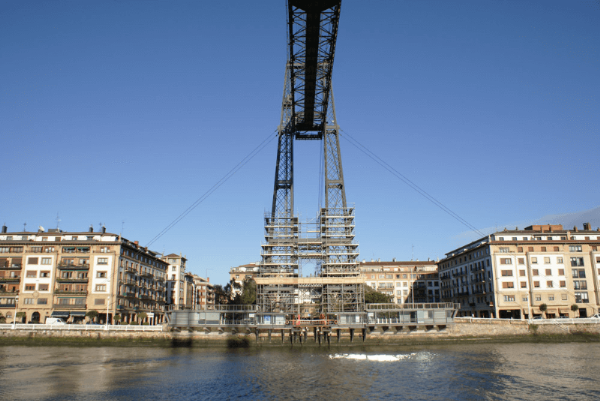
In this case, a long-term renovation was conducted on the Vizcaya Bridge, known for its protruding steel truss girder across a wide estuary and its tall towers. The renovation included surface repainting and the repair of wartime damage.
ULMA’s BRIO system was used on-site to prevent localized concentration of temporary loads and anchor installation. BRIO is a ring lock modular scaffolding system. The entire structure was covered with BRIO system, with the tower section supported from the ground and the horizontal section suspended from the truss. This minimized contact with the historical structure as much as possible.
This case is a good example of achieving both reduced load on existing structures and improved constructability by combining ground support and suspension support for high and elongated structures.
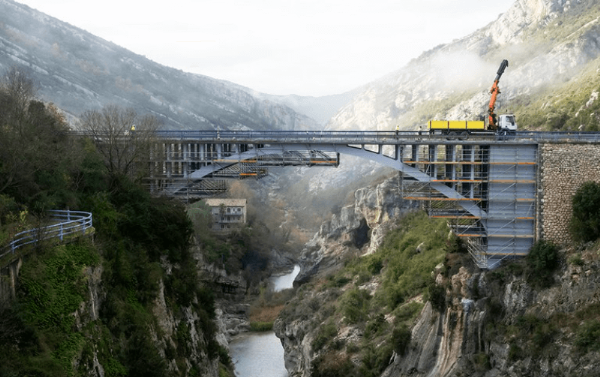
This is a case of bridge repair where maintaining uninterrupted traffic flow was a fundamental requirement. Using ULMA’s BRIO system, the scaffolding was assembled and dismantled by lowering it from the roadway while maintaining alternating one-way traffic.
By employing a cantilever method in which the scaffolding is suspended from the bridge deck, the plan enables repair work on the underside of the arch and the front face of the abutments without occupying the riverbed or the space beneath the bridge.
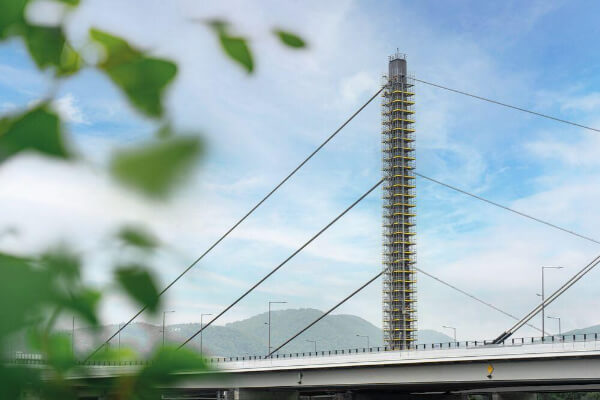
This case is an example of repairing a cable-stayed bridge. The Ringlock modular scaffolding system from Doka was used when performing repairs on the main tower of the bridge.
The scaffolding was assembled to surround the tower 360 degrees, providing workspaces that allowed simultaneous operations at multiple locations with different heights.
A distinctive feature was the installation of modular scaffolding with rosette connections without the need to install anchors in the ground. The interior of the scaffolding flexibly incorporated stairs and lifts for transporting materials, thereby creating a secure and safe system certified by the Deutsches Institut für Bautechnik (DIBt).
Advertiser Disclosure:
We receive compensation from some of the companies listed below.This compensation may affect which companies are included and the order in which they appear.
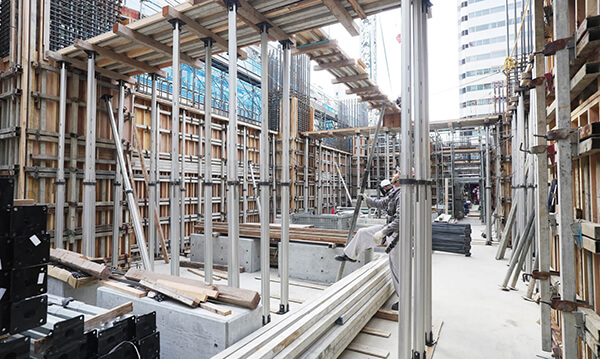
Source: https://www.forbuild.co.jp/material/alpa.php
| Unit Weight |
8.9/11.1 kg |
|---|---|
| Load Capacity |
19.0~36.0 kN* |
| Material | Aluminum |
| Max Length |
3,490mm |
*When the upper end is fixed to timber and the lower end to concrete
*Based on the ARPA 45 model.
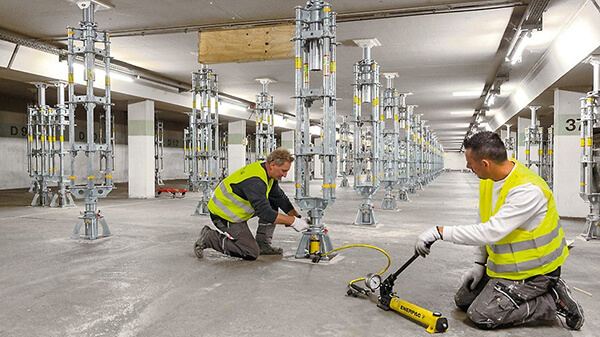
Source: https://www.peri.ltd.uk/products/peri-up-flex-heavy-duty-prop-hd.html
| Unit Weight |
91.03~265.98kg |
|---|---|
| Load Capacity |
Up to 200 kN |
| Material | Steel |
| Max Length |
Approx.8,330mm |
https://www.peri.ltd.uk/dam/jcr:cb5a5bf0-8e05-4d70-b6fd-780f3cf91333/peri-up-flex-hd-prop.pdf
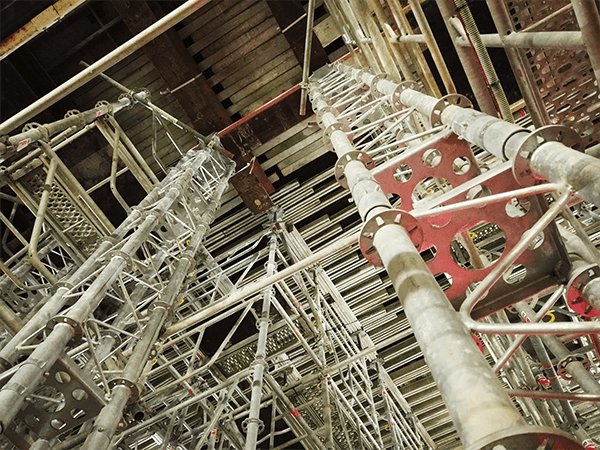
Source: https://www.altrad-coffrage.com/en/solutions/shoring/props/tetrashor.html
| Unit Weight |
Approx. 131–159 kg |
|---|---|
| Load Capacity |
Up to 400 kN* |
| Material | Hot-Dip Galvanized High-Tensile Steel |
| Max Length |
17,000mm* |
*Applicable to single-leg prop configuration onl
