Disasters impose sudden and complex burdens on construction and civil engineering sites. Ensuring safety and achieving temporary restoration of functionality become urgent priorities, requiring reliable design and execution across all stages—from assessment of damaged structures to shoring, emergency repairs, and the transition to permanent restoration.
This article summarizes case studies on restoration work during disasters and emergency support due to aging.

In 2010, a massive earthquake struck Chile, causing three bridges spanning the Biobío River, a major artery, to collapse or become damaged.
With urban functions and economic activities paralyzed by transportation disruption, the government deemed the rapid construction of a temporary bridge an urgent priority. In collaboration with the Ministry of Defense and the Chilean Army, the decision was made to adopt Acrow’s modular steel bridge system.
This modular bridge offered high strength, light weight, and rapid assembly, enabling it to open to traffic in just 81 days. In this way, Acrow’s modular bridge quickly restored transportation and logistics to areas isolated immediately after the disaster.
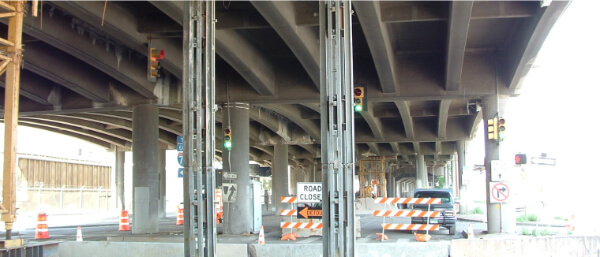
This is a case in which deterioration over time led to progressive damage to the bridge piers and pier caps, and structural members fractured during repair work. The load-bearing capacity of some sections of the bridge girders and deck had been compromised, significantly reducing the safety of both transit and repair operations.
In the field, under the guidance of the State Department of Transportation, the contractor adopted the Superprop® Shores system by Acrow. High-strength shoring capable of carrying loads up to 270 tons with a single column was quickly assembled and installed in the confined space of the median strip.
Acrow’s modular structural components can be easily reconfigured to accommodate changes in site conditions or design modifications.
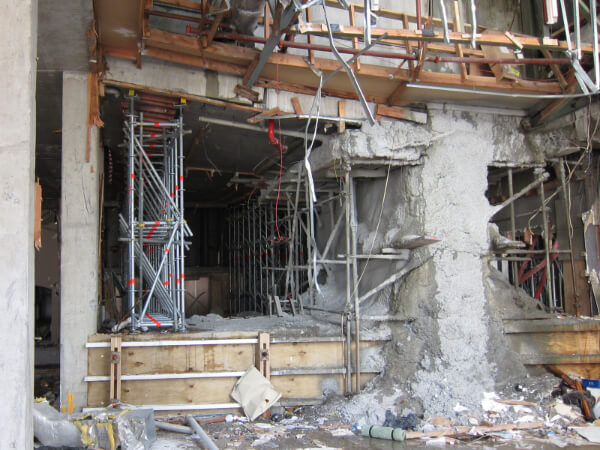
When super high-rise buildings sustain significant damage during an earthquake, posing a high risk of collapse, it is essential to stabilize the structure using shoring in parallel with demolition. At the same time, providing scaffolding, such as independent stair towers, is crucial to ensure safe access and egress routes for workers.
In this case, the primary cause was brittle failure of the shear wall at the southeast corner, which led to approximately 800 mm of settlement at that corner and about 1.3 m of horizontal displacement at the top of the building, triggering column damage and stair collapses.
Under the leadership of a general construction company, a scaffolding contractor implemented heavy-duty temporary shoring using Layher Allround. The project ensured access with a freestanding platform stair tower approximately 62 meters in height. More than 200 tons of equipment and materials, including high-capacity props formed by clusters of 16 standards, were used to support stabilization and safe, phased demolition.
The advantage of the modular system is its high degree of reconfigurability using common components, allowing flexible adaptation to changes in the demolition sequence.
Advertiser Disclosure:
We receive compensation from some of the companies listed below.This compensation may affect which companies are included and the order in which they appear.
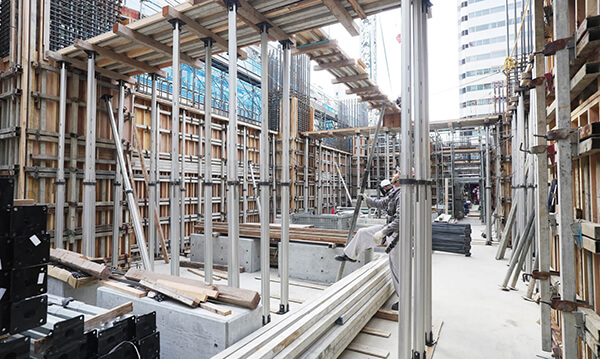
Source: https://www.forbuild.co.jp/material/alpa.php
| Unit Weight |
8.9/11.1 kg |
|---|---|
| Load Capacity |
19.0~36.0 kN* |
| Material | Aluminum |
| Max Length |
3,490mm |
*When the upper end is fixed to timber and the lower end to concrete
*Based on the ARPA 45 model.
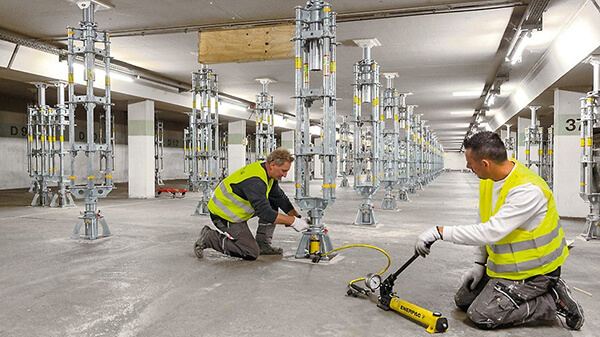
Source: https://www.peri.ltd.uk/products/peri-up-flex-heavy-duty-prop-hd.html
| Unit Weight |
91.03~265.98kg |
|---|---|
| Load Capacity |
Up to 200 kN |
| Material | Steel |
| Max Length |
Approx.8,330mm |
https://www.peri.ltd.uk/dam/jcr:cb5a5bf0-8e05-4d70-b6fd-780f3cf91333/peri-up-flex-hd-prop.pdf
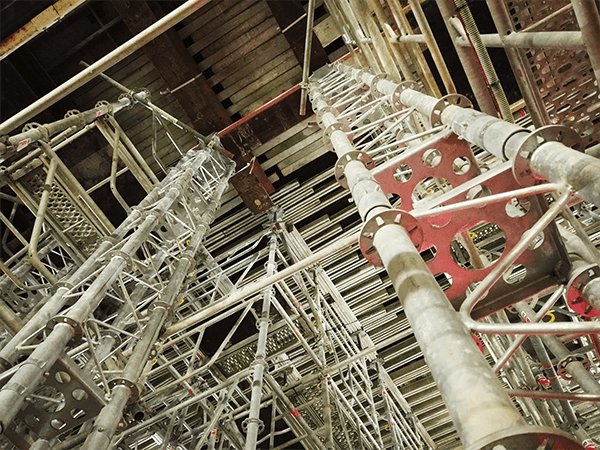
Source: https://www.altrad-coffrage.com/en/solutions/shoring/props/tetrashor.html
| Unit Weight |
Approx. 131–159 kg |
|---|---|
| Load Capacity |
Up to 400 kN* |
| Material | Hot-Dip Galvanized High-Tensile Steel |
| Max Length |
17,000mm* |
*Applicable to single-leg prop configuration onl
